


Opening product…

Remem
Sovereign, auditable memory for AI agents
 Sunday VictorPublished Aug 5, 2026
About
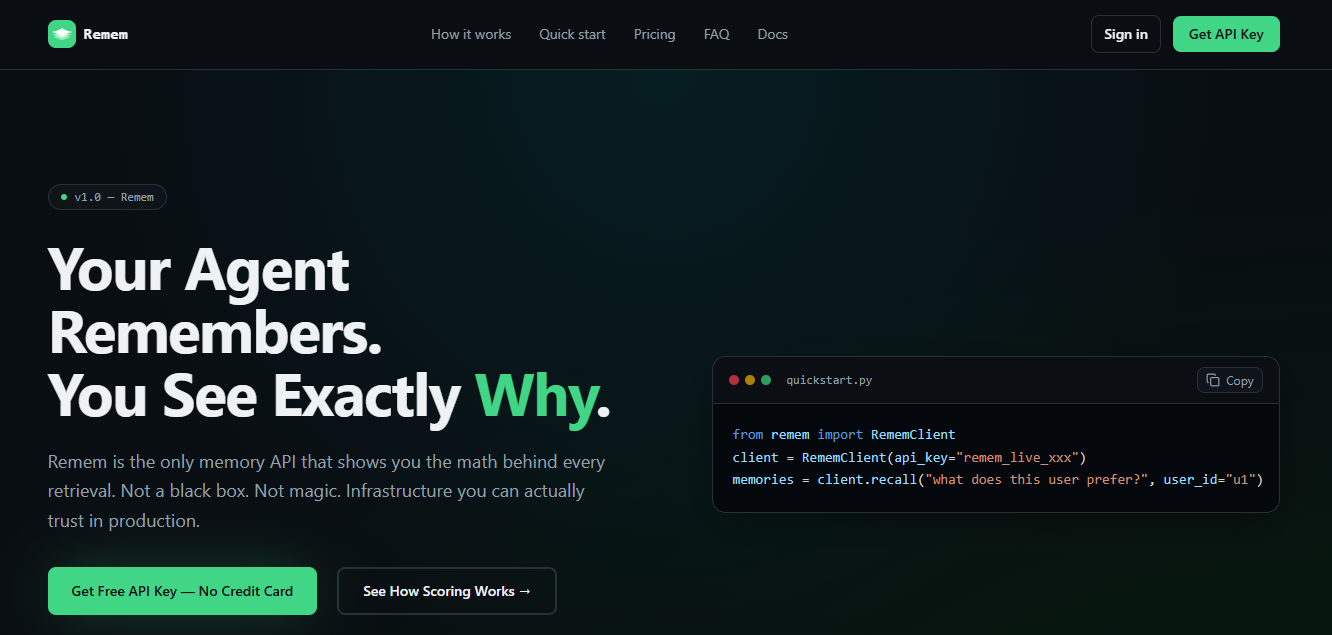
Remem gives AI agents persistent memory with full retrieval transparency: hybrid scoring (relevance, recency, importance) shows why each memory surfaced, and you control what's stored, retrieved, or deleted. No black box.
Product details
- Product type
- Pricing
- Useful for


Founder’s note

I built Remem because every agent framework I used made memory an afterthought, a summarization hack or a vector store bolted on with no way to see why a memory got retrieved or ask it to forget something. I wanted memory that's a first-class, inspectable part of the system: hybrid scoring that combines relevance, recency, and importance, full visibility into why a memory surfaced, and real control over what gets stored, retrieved, or deleted. I'm building this solo, currently in production hardening — swapping in better embeddings, tightening multi-tenant isolation, fixing the rough edges that only show up once real traffic hits it. The people I most want to reach are developers and small teams shipping production agents who need to trust what their agent remembers, not just demo it. What I'd still improve: deeper framework integrations (LangChain/CrewAI out of the box), a public benchmark page, and a smoother self-serve onboarding flow. Feedback from early users is what will shape all three.
Spotlight note
Even though we might have some critiques on the landing website, as it doesn't really give the tool any identity and looks like a simple SaaS website, we appreciate the idea: giving AI agents memory and rating how well they can retrieve it, as they explain exactly how they remembered certain stuff. A big problem in using AI agents and IDEs is that, at some point, context will be forgotten and re-understanding it will take credits which annoys users, so this could become useful for a lot of developer groups.
FAQ
Who is Remem for?
Developers and small teams building production AI agents (via LangChain, custom stacks, etc.) who need agents to remember users across sessions — and need to see why a memory was retrieved, not just trust a black box.
How does retrieval work?
Hybrid scoring: 70% semantic relevance, 20% recency decay, 10% importance weighting. Every retrieval is inspectable — you can see which memories were considered and why one ranked above another.
Can I delete or control what's stored?
Yes — full programmatic control over what's stored, retrieved, and deleted, per user/tenant/agent.
Share a note about Remem
Discussion is coming next — for now, upvote and visit the product.